

If you are comparing finasteride vs minoxidil results, you are probably not looking for theory. You want to know what is more likely to work, how long it takes, and whether one option is worth your time, money, and daily effort. That is the right question to ask, because while both treatments are widely used for male pattern hair loss, they do not deliver the same kind of result.
For most men with androgenetic alopecia, finasteride is better at slowing or stopping further loss. Minoxidil is often better known for encouraging visible regrowth, especially in areas where hair has thinned rather than disappeared completely. The strongest results often come from using the right treatment at the right stage of hair loss, rather than assuming one product is simply "stronger" than the other.
Finasteride vs minoxidil results at a glance
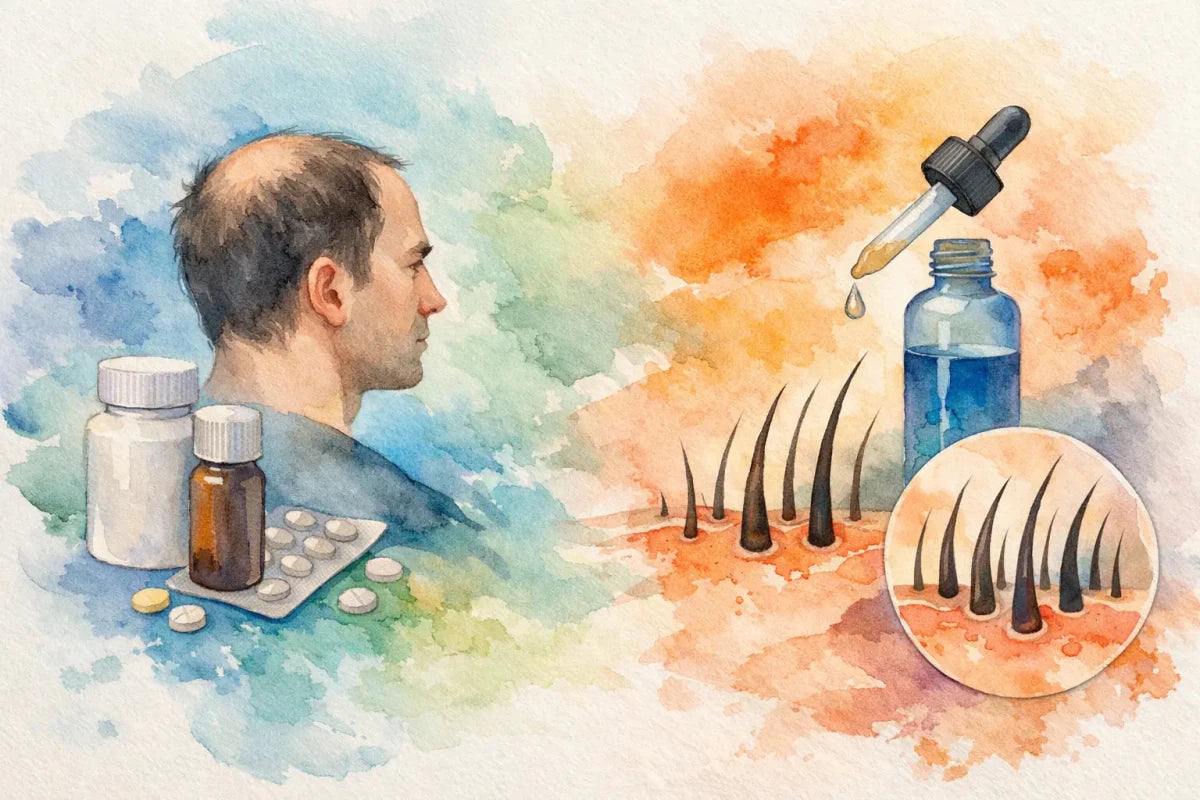
The key difference is mechanism. Finasteride works internally by reducing levels of dihydrotestosterone, or DHT, which is one of the main drivers of male pattern baldness. Minoxidil works externally on the scalp and is thought to improve blood flow and prolong the growth phase of the hair cycle.
That difference matters because the outcome is different too. Finasteride is usually chosen to protect what you still have. Minoxidil is often chosen to stimulate weaker follicles and improve density. If your priority is preventing ongoing recession or thinning at the crown, finasteride often has the edge. If your priority is filling in visibly thinner patches, minoxidil may produce more obvious cosmetic change, although that result can be less predictable.
Neither treatment works overnight. Hair grows slowly, and any treatment needs time before it can be judged properly.
How quickly do results show?
This is where expectations often drift away from reality. Many people hope for a clear answer after four weeks, but that is rarely enough time.
With finasteride, the first meaningful result is often stabilisation rather than regrowth. In practical terms, that may mean less hair falling out in the shower or less noticeable shedding over several months. Many men need at least three to six months before they can judge whether it is helping. More visible thickening, if it happens, may take six to twelve months.
Minoxidil can also take several months to show clear benefit. Some users notice increased shedding early on, which can be unsettling but is sometimes part of the transition as older hairs are pushed out. That does not happen to everyone, and it does not automatically mean the treatment is working well, but it can occur. Most people need to use minoxidil consistently for at least three to six months before deciding whether it is effective.
If speed is your main concern, neither option is genuinely fast. They are long-term treatments, not short-term fixes.
Which treatment gives better regrowth?
When people talk about results, they often mean regrowth. The answer depends on where the hair loss is happening and how advanced it is.
Minoxidil tends to be more associated with visible regrowth, particularly at the crown. It can help some men thicken miniaturised hairs and improve overall density. The earlier you start, the better the chance of seeing a worthwhile cosmetic change.
Finasteride can also lead to regrowth, especially in men who start treatment earlier, but it is often more reliable for halting progression than for reversing significant loss. That may sound less exciting, but stabilising hair loss is a strong result. Holding on to existing hair can make a major difference over the next few years.
If hair follicles have been inactive for a long time, neither treatment is likely to bring back a fully bare area. That is one of the most important limitations to understand. These medicines work best on thinning hair, not smooth bald scalp.
Crown results vs hairline results
This is where expectations need to be precise. Both finasteride and minoxidil tend to perform better at the crown than at the frontal hairline. Hairline regrowth is possible, but usually less dramatic and less consistent.
Finasteride may help slow further recession at the temples, which is valuable even if it does not rebuild the hairline in a noticeable way. Minoxidil may improve some frontal thinning, but results here are often modest. If your main concern is a mature or receding hairline, it is sensible to expect preservation first and regrowth second.
Finasteride vs minoxidil results for long-term use
Hair loss treatment is really about maintenance. Both medicines only work while you continue using them.
With finasteride, stopping treatment usually means DHT levels return to their previous pattern, and hair loss may resume over time. The same principle applies to minoxidil. If you stop, any benefit gained is usually lost gradually over the following months.
This is why convenience matters. A treatment that looks good on paper but does not fit your routine is harder to stick with. Finasteride is usually taken as a once-daily tablet, which many people find easier to maintain. Minoxidil needs regular topical application, often once or twice daily depending on the product. That extra step can affect adherence, especially for people with busy schedules.
The best treatment is not only the one with the strongest data. It is the one you are realistically willing to use consistently.
Side effects and trade-offs
Results are only part of the picture. A treatment also has to feel acceptable from a safety and convenience point of view.
Finasteride is prescription-only in the UK and requires a clinician to assess suitability. Some men are concerned about potential sexual side effects, such as reduced libido or erectile difficulties. These side effects are not experienced by everyone, but they are important enough to discuss properly before starting treatment. For the right patient, the benefit-risk balance can still be very reasonable, but this is not something to brush aside.
Minoxidil does not affect DHT, so it avoids that specific issue. Its downsides are usually more practical. Some users develop scalp irritation, itching, dryness, or find the product awkward to apply around styling or washing routines. Foam and solution formats can feel different in day-to-day use, and that can influence whether someone continues.
In other words, finasteride often asks for more medical consideration. Minoxidil often asks for more daily effort.
Is using both better than choosing one?
Often, yes. Because they work in different ways, finasteride and minoxidil are commonly used together. One aims to reduce the hormonal driver of hair loss, while the other supports growth at the follicle level.
For men with ongoing thinning who want the best chance of preserving and improving hair density, combination treatment can make sense. It is not guaranteed to transform results, but it may outperform either option alone, particularly when started before the hair loss becomes advanced.
That said, more treatment also means more commitment. You are managing both a prescription medicine and a regular topical routine. For some people, starting with one treatment first is more realistic, then reviewing the response after several months.
Who should choose finasteride?
Finasteride often suits men with clear signs of male pattern hair loss who want a convenient daily option aimed at slowing progression. It can be a strong choice if shedding is continuing, the crown is thinning, or the hairline is still changing and preservation matters more than chasing quick cosmetic gains.
It is especially relevant for men who want a clinician-led treatment plan rather than trying products at random. Through a regulated online pharmacy and telehealth service such as Rightangled, treatment can be assessed discreetly and efficiently, with medical oversight built into the process.
Who should choose minoxidil?
Minoxidil may suit men who prefer to start with a non-prescription treatment, are focused on visible thickening, or are not suitable for finasteride. It can also be a practical option for those who want to target thinning at the crown and are comfortable with applying a product to the scalp consistently.
It is less about blocking the cause and more about supporting the follicles you still have. That can be worthwhile, particularly in earlier stages of hair loss.
The most realistic way to judge results
Photos matter more than memory. Hair loss changes slowly, and so do treatment results. If you rely on the mirror alone, it is easy to miss subtle improvement or assume nothing is happening.
Take photos in the same lighting, from the same angles, once a month. Give the treatment enough time. Three months is often too soon for a fair verdict. Six months is more useful. Twelve months gives a much clearer picture of what your baseline response looks like.
If there is one thing worth remembering, it is this: good hair loss treatment is often less dramatic than people expect, but more valuable than they realise. Keeping the hair you have, slowing the rate of change, and building modest regrowth over time can be a very good result.



Partager:
Best Online Weight Loss Clinics in the UK
Mounjaro vs Wegovy differences explained